
The Endgame of Software!
When intent becomes the interface, the UI becomes optional.

The software layer is fading away.
If you don’t adapt to this new tech stack,
your app may be next to be replaced by AI.
You might feel a little overwhelmed while reading this.
Some of you may disagree with what comes next. That’s fine.
I’m not here to convince you of anything. The only thing I ask is that you read this without mental restrictions. Let your thoughts wander. Don’t rush to defend what you already know.
If this feels uncomfortable, it’s worth asking why.
Sometimes that discomfort comes from years spent mastering a system that’s now changing faster than expected. Other times, it comes from not yet seeing what’s possible.
Most people are waiting for AGI to arrive.
They don’t realize we’re already living in its early form.
It’s here, scattered across systems, models, tools, and agents. Not as a single entity, but as fragments of intelligence working together.
What’s missing isn’t capability.
It’s permission.
The moment we stop holding it back, it won’t assist us anymore.
It will lead.
For decades, we’ve been building software the same way.
Apps. Dashboards. Buttons. Menus. Settings.
More features meant more power. More screens meant more value.
That era is ending.
Not because software is failing, but because humans no longer want to operate machines.
They want outcomes.
Software was built for human limits
Traditional software exists because humans are slow.
We needed interfaces to click, forms to fill, workflows to follow, tutorials to learn. Software adapted itself around human effort so things wouldn’t break.
But AI flips this completely.
Now systems can read, understand, decide, and act on their own. The human no longer needs to “use” the tool.
All they have to do is just state the intent.
“Do this.”
“Find that.”
“Make this happen.”
Everything else becomes noise.
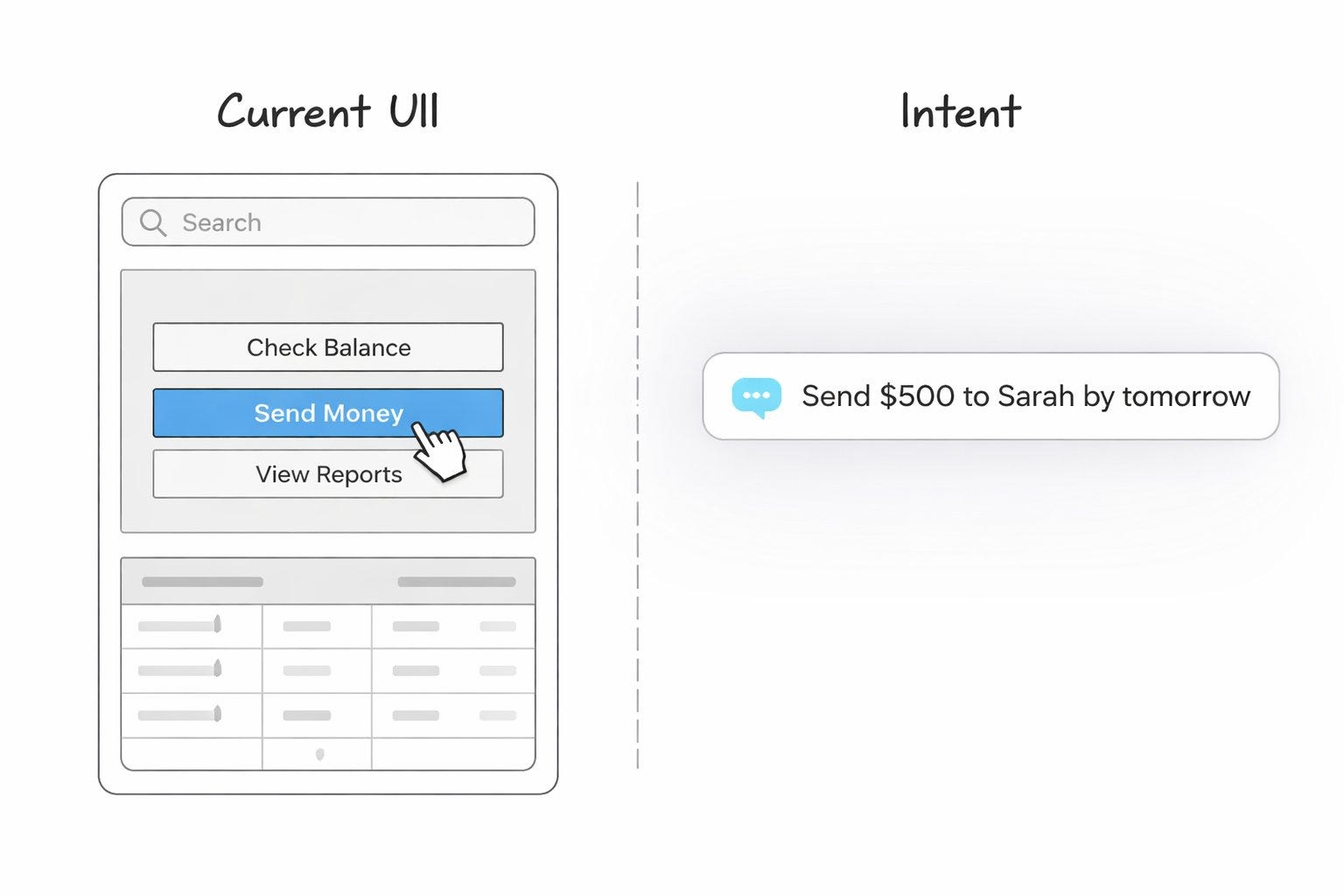
Intent becomes the interface
When intent becomes the interface, the UI becomes optional.
You don’t need a project management app, a CRM dashboard, or a dozen SaaS tools stitched together. You need one system that understands context, goals, constraints, and feedback.
And executes.
Software stops being something you open.
It becomes something that runs.
Quietly. Continuously. Invisibly.
From apps to agents
Apps wait for humans.
Agents don’t.
Agents monitor, decide, execute, and improve without asking for constant input. They don’t need you clicking buttons all day. They need permission once, then they handle the rest.
This is why most SaaS products are in danger.
If your product exists mainly as a UI, a workflow, or a manual process wrapper, an agent can replace it. Faster, cheaper, and always on.
Features are dead. Outcomes win.
Old software sold features.
New systems deliver outcomes.
Nobody cares how many toggles your app has if an agent can get the same result with less effort, in less time, and with zero learning curve.
Value shifts from
“Look what our product can do”
to
“Here’s what got done.”
That’s the real disruption.
The tech stack is changing
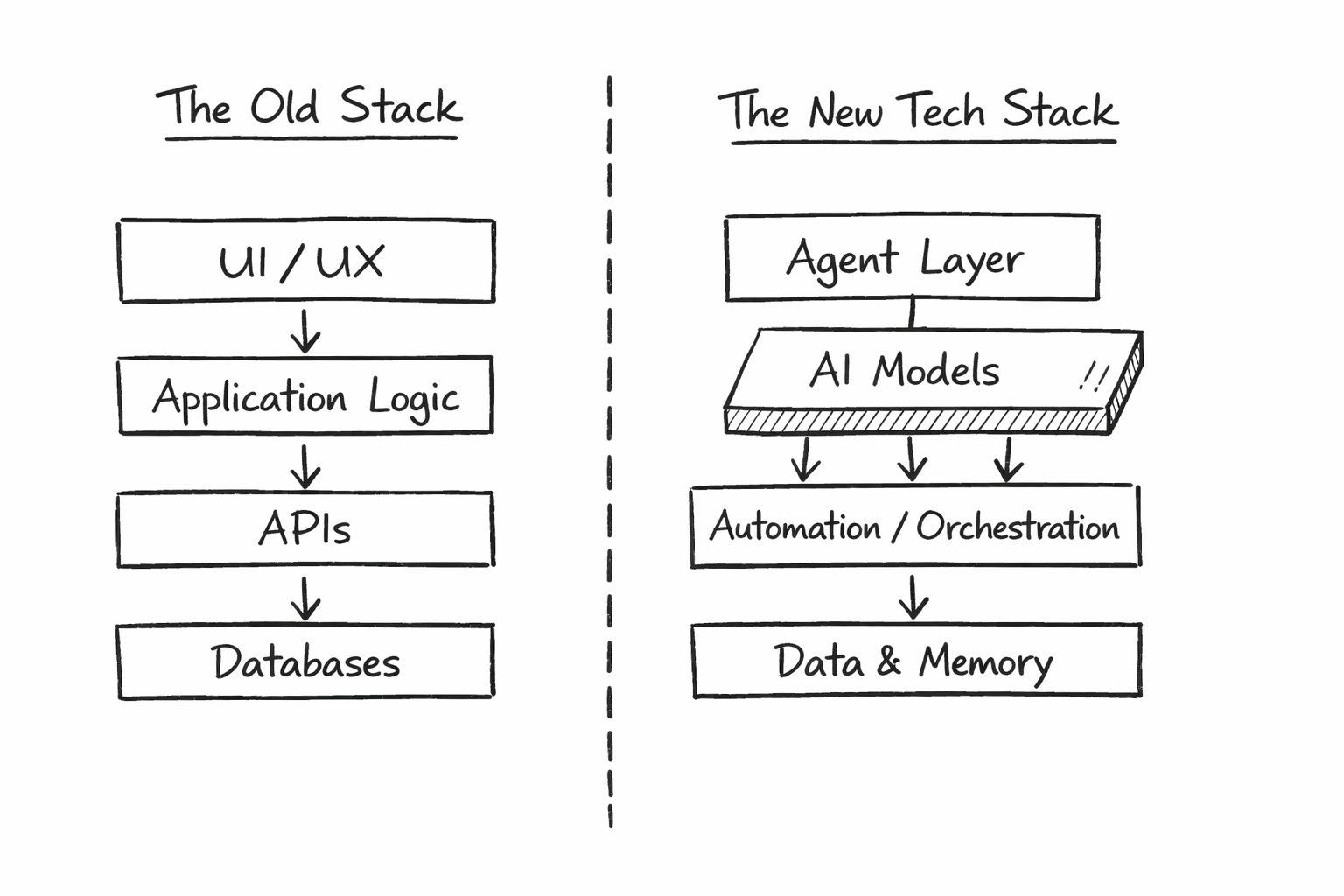
Every era of software has a tech stack.
The old stack was built for humans.
At the top most layer, we had Apps. Screens. Dashboards. Buttons.
Below that were workflows and logic.
Below that, APIs and servers.
At the bottom, compute.
Everything pointed upward, toward the interface.
Humans sat at the top, driving everything manually.
The new stack flips this completely.
There is no permanent “app layer” anymore.
At the base, compute still exists. That doesn’t change.
On top of it sit protocols and execution environments where agents can safely run.
Above that, the real primitives emerge.
Rules define what an agent is allowed to do.
Constraints define what it must never do.
Permissions define who or what it can act on behalf of.
Trust defines which tools, data, and signals it can rely on.
Memory gives it continuity across time.
This becomes the new foundation.
The new tech stack.
On top of this stack, AI generates everything else.
If a UI is needed, it’s created on the fly.
If a workflow is needed, it’s assembled dynamically.
If logic is needed, it’s written, executed, and discarded.
Nothing is fixed.
Nothing is shipped permanently.
The app becomes a temporary shape, not a product.
AI will create interfaces on the fly
Here’s the part most people underestimate.
AI is getting smart enough to create software as needed.
If an interface is required, an agent can generate it.
If a workflow is needed, it can assemble it.
If logic is required, it can write and execute it.
(Considering that it has the access to the new tech stack we’ve discussed above.)
The interface is no longer shipped.
It’s generated.
Based on rules we define.
Based on context.
Based on the task at hand.
Static apps start to feel pointless when systems can build what they need in real time.
Screens were never the end goal
Smart Phones are a limitation, not a destination.
Staring at rectangles all day was never the future. It was just the best option we had.
Smart glasses make more sense to me personally.
Always available. Context aware. Hands free. Minimal by default.
When agents handle execution, you don’t need full screens. You need light feedback and occasional confirmation. The interface appears when needed, then disappears again.
Software fades into the background.
Reality stays in front.
SaaS doesn’t disappear. It dissolves.
This doesn’t mean software companies vanish completely.
They either evolve or fade into The Abyss.
SaaS becomes infrastructure, APIs, Primitives, Capabilities, agents can call quietly in the background.
The brand moves away from the UI and into the system itself.
If your software can’t work without a human babysitting it, it will struggle.
Builders don’t ship apps anymore
They ship systems.
They design decision layers, execution layers, feedback loops, trust, and permissions.
The best builders won’t chase UI trends.
They’ll chase leverage.
Invisible leverage.
The endgame
The endgame isn’t AI replacing developers.
It’s software no longer needing users.
Humans move up the stack.
Machines handle the rest.
We’re not killing software.
We’re freeing it from us.
And once that happens, there’s no going back.
Here’s my previous post in case you want to unlock your Vibe Coding Superpowers.
