
Unlock Your Vibe Coding Superpowers.
Read this before starting your vibe coding journey.

This is not your regular vibe coding article.
I won’t tell you how to vibe code.
Instead, I’ll show you how to become the best vibe coder in existence.
Prelude:
This post is all about building your mindset in a way that you don’t think like the 99% of the wannabe vibe coders out there.
What I’m going to do is try to shape your psychology so that when you read my future posts or think about doing vibe coding again, you think like a real builder. Someone who doesn’t just talk, but actually ships great products. Someone who truly cares and adds real value to the society.
Vibe coding is easy, building something meaningful is not.
This post is an effort to put your brain in the frequency spectrum required to unlock the superpowers of vibe coding and eventually become the best vibe coder in existence.
This might be a bit lengthy, and I’m not going to try to make it short for anyone. I’ll write everything that’s required to reach the goal of this article. If you’re in a hurry, bookmark it and come back later.
It takes hard work and dedication to become the best.
Shortcuts won’t get you there.

You don’t need to learn “How to Vibe Code”
Just reading posts and articles about “how to vibe code” is honestly not the best way to learn how to vibe code or build great products.
If you’re reading this, I bet you’ve read at least one vibe coding post or article in the past week.
And that’s great. It either means you want to build something you’ve always dreamed of, or you just don’t want to feel like you’re missing out.
Both are totally normal.
But what’s not normal is trying to ‘learn’ how to vibe code. You don’t need to learn that. You can already talk your way with LLMs to build magical apps.
All you need is one AI subscription and a dream.
(You don’t even need a paid subscription tbh.)


I know a lot of people out there are spending time reading useless, repetitive vibe coding guides, which really isn’t necessary.
You can simply talk to an LLM like ChatGPT or Claude, and it will turn your idea into an app and will also guide you at every step in the process. In fact, it will often add more features than you even asked for.
Coding and reasoning models like GPT-5.2 and Opus 4.5 are trained to do exactly this. All you have to do is explain your idea in your own language and be resilient enough to try again and again until the result actually satisfies you.
That’s basically it for “how to vibe code.”
But that alone is not enough to build great products that are error-free, scalable, user-friendly, and stable.
Please don’t get me wrong. There are many vibe coding and prompting techniques that can genuinely help you on your journey and speed up the process. The problem isn’t a lack of tools or even reading such articles and posts. It’s the lack of the right direction and mindset required to build great things.
The first step is building the right mindset and heading in the right direction. Only after that, one should look for tools that make the journey easier, faster, and better.
If you’re asking yourself why you should believe anything written in this article, read the next section.
My Vibe Coding Journey.
I’ve shipped dozens of production-ready apps using vibe coding.
Checkout:
After more than 1.5 years of vibe coding experience, consuming millions of tokens, training multiple people, and delivering tens of working, vibe -coded production ready apps, I believe I have enough experience to help you start your vibe coding journey and turn your idea into something real that can actually last.
I made many mistakes along the way, but I also believe I’ve found the key to building almost anything I can imagine.
Now, I want to share that experience with all of you who want to turn great ideas into real, tangible, production-ready, scalable products.
Not demos.
Not prototypes.
Real products.
What you actually need to learn.
If you’re still here reading this article, it means you believe that what I’m saying makes sense, and that there’s more to vibe coding and building great products than just making apps using AI.
I’ll assume you’re a doer rather than just a thinker, and that you’ve already tried building some basic app using AI. If you haven’t, stop reading this right now. You need to get your hands dirty in the sand before learning how to design and build a real castle.
So let’s break down the principles and mindset cues that separate people who just vibe code from those who ship real, lasting products with it.
1. Solve a real pain point
If you’re not solving a real problem, nothing else matters.
Vibe coding makes it easy to build something, but that doesn’t mean it’s worth building.
Before touching AI, you should be able to clearly answer: who is this for, and what pain does it remove?
Great products aren’t born from features. They’re born from frustration.
If users don’t feel pain, they won’t care.
2. Understand the basics of software architecture
You don’t need to go super technical or deep, but you do need a basic mental model of how an app works and how it’s structured.
If you vibe code without understanding the basics of software architecture, you’ll constantly hit roadblocks. Once you have a rough idea of things like:
Where does the data live?
What talks to what?
What breaks if this fails?
you’ll be in a much better position to build something solid and handle issues when they inevitably show up.
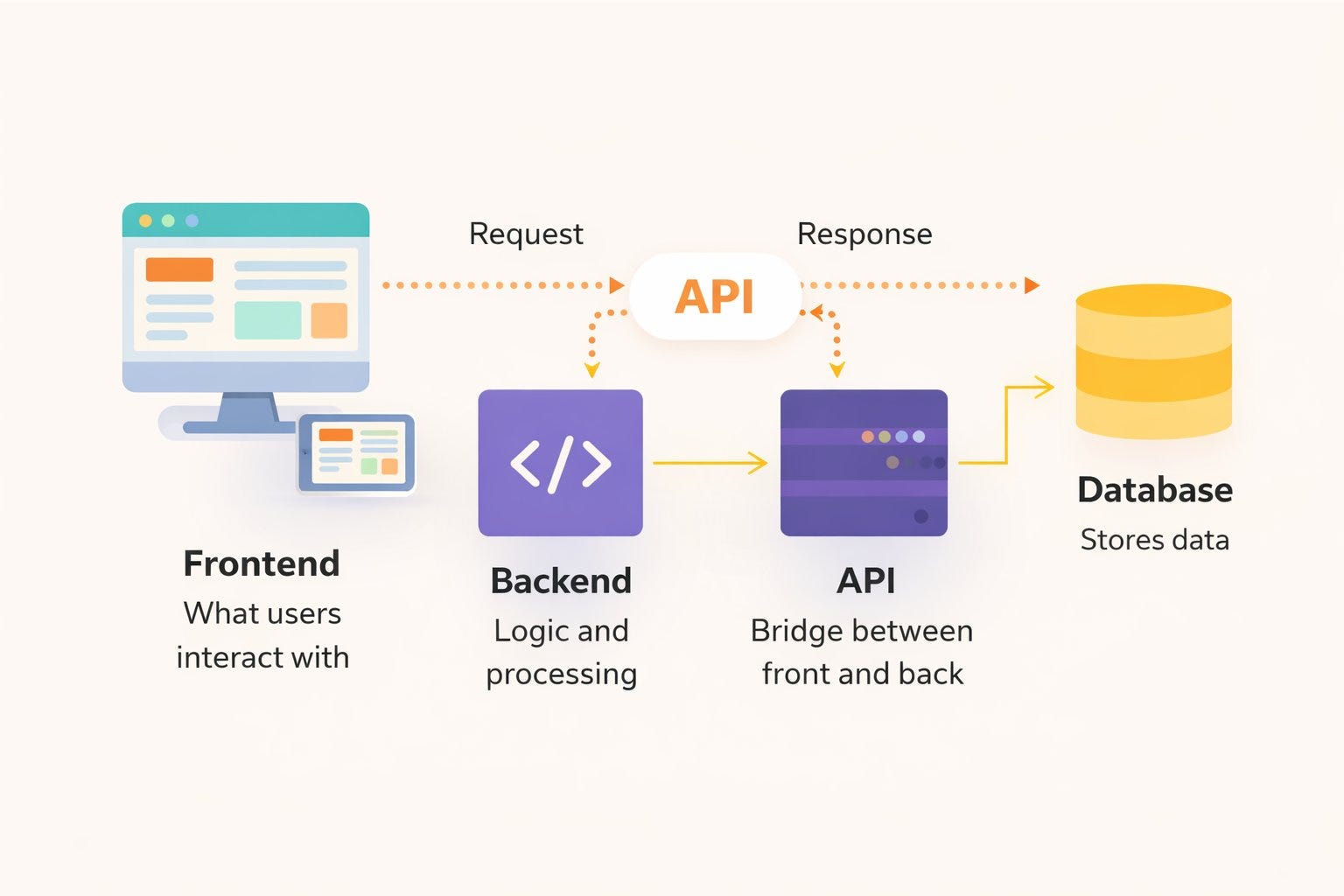
Here’s a simple breakdown of the core pieces:
Frontend: The part users see and interact with. Buttons, pages, and flows live here.
Backend: The logic layer that decides what happens when users do something. Users/Clients requests data from servers via frontend/ui and server responds to frontend.
Database: Where all your data is stored and retrieved from. example leaderboard data.
API: The bridge that lets the frontend and backend communicate safely.
3. Ship fast, then iterate relentlessly
Your first version will be wrong. Always.
The goal isn’t perfection. The goal is feedback. Shipping early exposes blind spots no amount of prompting can predict.
Vibe coding shines when paired with iteration. Build, ship, learn, improve. Repeat.
Momentum beats overthinking every time.
4. Reverse-engineer features from users
Users often don’t ask for features. They reveal them through behavior.
Watch what they click, ignore, complain about, or work around, and then reverse-engineer features from those signals.
The most useful feature ideas usually won’t come from your imagination. They come from users’ struggles, friction, and complaints.
5. Users matter more than features
A feature that nobody uses is technical debt.
Builders often fall in love with what they build instead of who they build for. Vibe coding makes feature creation cheap, which makes this trap even more dangerous.
Always ask: does this make life better for the user?
If not, don’t add it to the production.
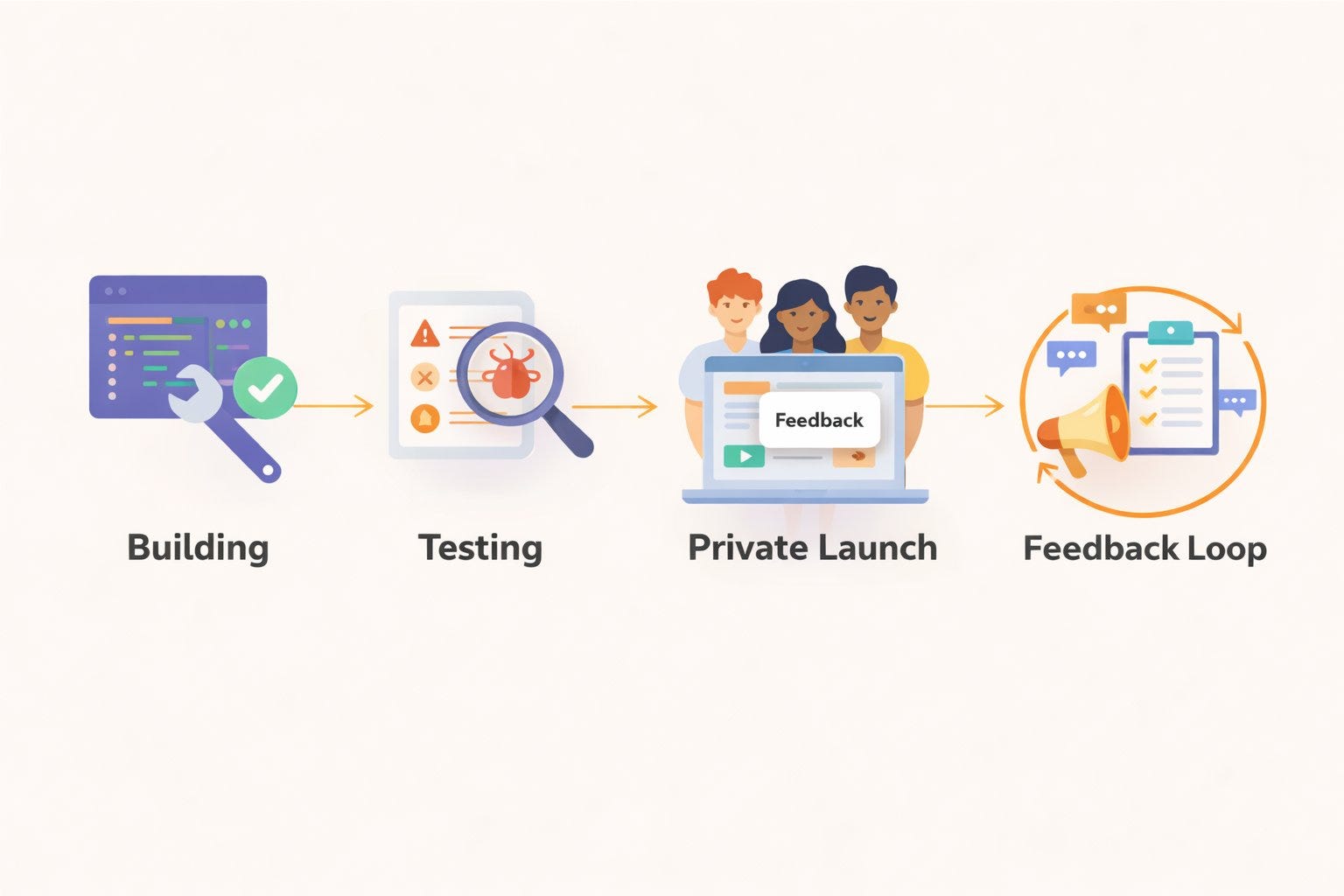
6. Testing is non-negotiable
f you don’t test, your users will test for you.
AI can generate code quickly, but it can also introduce subtle bugs. Testing is how you catch those issues before they reach users.
Start with simple sanity checks.
Manually test every core flow and feature. Click through your app like a real user would.
Before a public launch, release the product privately to a small group of friends or early users. Real usage will surface bugs you would never think of on your own.
And remember, bugs aren’t just UI issues. They include logic errors, payment failures, security loopholes, broken edge cases, and anything that causes confusion or loss of trust.
Testing is not a phase you rush through. It’s how products earn reliability.
7. Watch what the agent is doing at every step
If you can’t read the code, don’t worry, but don’t blindly accept AI output either.
After every task, ask the AI to generate a simple, easy-to-understand report of what it changed and why (You can add it in rules file as well, we will touch that in later posts) . Ask it to explain the logic in plain English, list the files it touched, and call out anything risky or unclear.
This is how you level up while vibe coding.
You learn by watching, understanding, and catching loopholes or bugs before they reach users.
AI can code for you and manage technicality, but you need to be the brains behind every decision.
8. Make conscious tradeoffs under real constraints
You can’t have everything at once.
Sometimes you ship faster but accept a few rough edges. Sometimes you keep things simple instead of adding every feature. Sometimes you choose cheaper solutions before scaling big.
Great builders are aware of these tradeoffs and choose intentionally instead of letting things happen by accident.
Constraints aren’t blockers. They help you decide what actually matters right now.
9. Stay updated with relevant tech trends
You don’t need to chase every new tool.
But you do need awareness. Knowing what’s possible helps you avoid reinventing the wheel and spot opportunities earlier.
When you stay updated, you can quickly use new launches, integrations, or open-source alternatives inside your own tools and stay ahead of the curve.
The goal isn’t hype. The goal is leverage.
10. UX and design matter more than you think
Users don’t care how smart your system is if it feels confusing.
A clean, intuitive experience turns average tech into great products. Bad UX can destroy even the most powerful products.
Design is not decoration. It’s communication.
11. Take full ownership of what you ship
“You can’t blame the AI” is a core rule.
If something breaks, leaks data, or frustrates users, it’s on you. Ownership forces responsibility, and responsibility forces quality.
Great vibe coders think like owners, not prompt engineers.
12. Adaptability is the biggest virtue
Your ability to adapt matters more than any tool, framework, or prompt.
Things will change. Tools will break. New models will show up. The builders who last are the ones who adjust without ego and keep moving.
Adaptability turns uncertainty into an advantage.
If you made it this far, I hope you learned something useful from this post.
This wasn’t meant to teach you how to vibe code. It was meant to help you think like someone who actually ships meaningful products using vibe coding.
In the upcoming posts, I’ll go deeper into the practical side of vibe coding. I’ll cover prompting techniques that actually work, shipping full-stack apps end to end, getting out of loops when AI gets stuck on a problem, running multi-agent systems, using Ralph for fully autonomous app development, creating great UX and beautiful landings that actually sells and much more.
Stay tuned. There are a lot more vibe coding superpowers to unlock.
Thanks for reading.
Some of my vibecoded websites and apps:
EventHorizon Labs: ehlabs.xyz
GIFU AI: gifu.ehlabs.xyz
KONK: app.kiyosonk.xyz
x402 Singularity Layer: x402Layer.cc
Screenshot App: www.screenshot.work
and many more.
Woaahh, hell lot of knowledge and learning in a single post 👏